

The Cosmic Blueprint
BHAGAVATA PURANA DEEP DIVE - Edition 43 - Creation, Time, and the Divine Puzzle of Existence
The Bhagavad Gita reveals Krishna’s words and instructions, while the Bhagavata Purana unveils His heart and nature—to know Krishna fully, one must hear both His voice and His story, and that’s exactly what this Deep Dive series offers: a guided journey into the soul of devotion.
For previous editions of the BHAGAVATA PURANA DEEP DIVE CLICK HERE.
How does the universe emerge from nothing? What are we to make of time—not just as seconds and hours, but as a cosmic force? What is the subtle difference between creation and illusion, between action and knowledge?
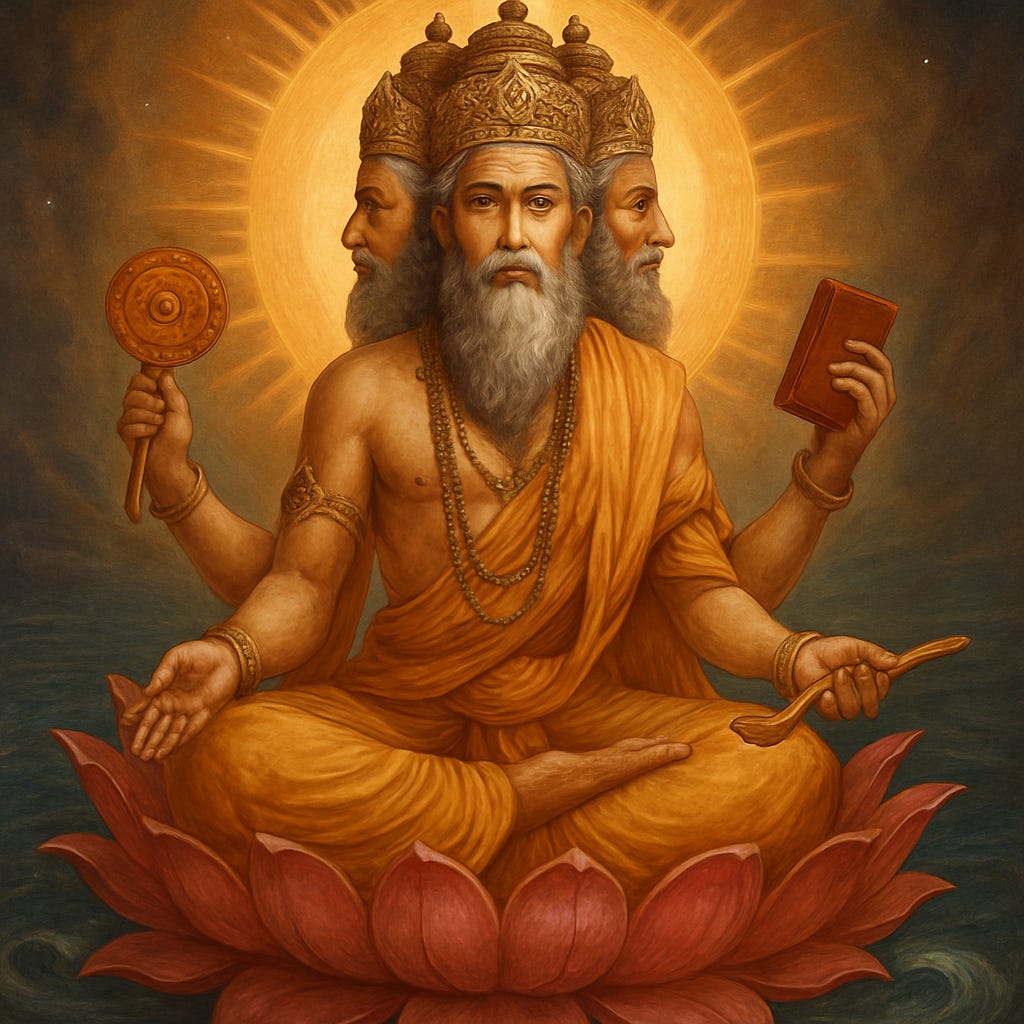
These are the profound themes that the Bhagavata Purana’s third book begins to unfold more expansively in Chapters 10 to 12. Following the divine instructions from the previous chapter, Brahma now sets in motion the act of creation—not merely populating the universe with life forms, but also laying out the very framework through which creation becomes possible.
Let’s walk through the layered mysteries encoded in these verses.
Brahma’s Ascent Through Austerity
The journey begins with Brahma performing intense austerities for one hundred divine years. His goal isn’t just to "create" in a mechanical sense, but to first align himself with the supreme source of all creation. He centers his own self on the deeper Self—the divine, formless one beyond all beginning.
But creation doesn’t begin with physical forms. It begins with turbulence. The wind howls. The waters churn. Even the lotus on which Brahma sits is shaken. This chaos isn't accidental. It's symbolic. Before order, there must be agitation. From disturbance, realization is born.
Through deeper insight, Brahma absorbs the turbulence. He swallows it, both figuratively and literally, regaining his composure and anchoring himself in knowledge. His perspective widens. He sees the lotus spreading out, encompassing the universe. This vision becomes the seed of future worlds.
Fourteen Realms: A Map of Experience
Urged into action by the Supreme, Brahma enters the lotus bud and divides it—first into three, then into fourteen layers of reality. These are not merely physical regions. They are layers of existence: realms of consciousness, karma, and spiritual development.
At the top are higher spiritual planes, inhabited by virtuous beings and sages. In the middle, the human realm—our familiar world, teetering between duty and desire. Below, regions shrouded in ignorance and suffering. This mapping is not just cosmic—it's psychological. We too live across layers. We rise or fall depending on the clarity of our perception and the integrity of our actions.
Time: The Unseen Architect
Vidura, our seeker-guide, now asks about time. Not hours and minutes—but cosmic time. The response reveals that time is a divine manifestation with no physical form, yet it governs everything. Even the gunas—those three primal qualities of nature—function under its watch.
Creation, too, unfolds in steps. First comes Mahat—the cosmic intelligence. Then comes ego, followed by the subtle senses and elements. Later emerge the senses of knowledge and action. The mind is formed, then the veil of ignorance—perverse intelligence, desire, and delusion.
This ladder—from light to darkness—shows how consciousness descends when it's disconnected from the source. But these are only the first six stages of creation, arising from nature herself. A second stream now emerges—called vikriti, or secondary creation, born of divine intention and reflective of action (rajas).
Life Forms: The Divine Classifications
Brahma now generates a spectacular array of beings. First, the immobile: trees, herbs, and plants. Then the lower animals—categorized in meticulous detail—those who can smell but not remember, those with split hooves or five nails, those with wings or without, predators and prey.
Eventually, humans are born. These beings are driven by action (rajas), ceaselessly pursuing goals—even in misery, convinced they are chasing happiness.
But creation does not stop there. The gods, ancestors, and celestial spirits follow. These higher beings inhabit more refined planes, but like us, are subject to karma and time. The gods too have lifespans, deaths, rebirths, and duties. The act of creation, then, is not a linear process. It is fractal—repeating itself at different levels of refinement.
The Atom and the Ages: A Cosmic Clock
The context then shifts into an extraordinary meditation on time, showing just how deeply the Purana blends spirituality with subtle cosmology.
It begins at the atomic level—describing a particle so fine it cannot be divided further. From this, larger measurements are built: paramanu, anu, trasarenu... all the way to moments (trutis), seconds (lava), and hours (muhurtas). Even the time it takes a golden needle to sink in water is accounted for.
From there, the text moves outward—days, nights, lunar months, seasons, years. Human lifespans. Lifespans of gods. The day and night of Brahma. Four yugas make one cycle. A thousand such cycles make one day for Brahma. And a night of equal length follows.
This relentless march of time isn’t impersonal—it is the expression of the Supreme. The Lord, unmanifest and all-pervasive, dwells within the smallest unit of time and the largest cycle of existence. Time isn’t just a measurement; it’s a divine power. It creates, sustains, and dissolves.
The Yugas and the Turning of Dharma
In every cycle, four yugas unfold: the age of truth (Satya), the age of rituals (Treta), the age of doubt (Dvapara), and the age of discord (Kali). Dharma, personified as a being with four legs, loses one limb in each yuga. In Kali (the present age), only one remains.
Despite the decay, a divine presence reappears in each era to guide and preserve. These are not always gods descending in visible form—they are also laws, virtues, and quiet miracles in the lives of sincere seekers.
Destruction: A Return to Silence
Each day of Brahma ends in a deluge. Not just a flood, but a cosmic silence. No sun, no moon, no action. A fire rises from within the Lord's serpent form and devours the worlds. Those with refined karma—like sages—ascend to higher realms. Others dissolve into elements, waiting for rebirth.
Hari (Krishna), the Lord, sleeps amidst the waters, resting on Ananta, the serpent of infinity. Even sleep is divine when it holds the seeds of creation.
A Difficult Creation: Anger, Austerity, and Divine Intervention
The next conversation brings us back to Brahma’s difficult task. After creating beings from darkness—ignorance, delusion, and pride—he’s dissatisfied. He meditates again and brings forth enlightened sages: Sanaka, Sanatana, Sananda, and Sanatkumara. But these sons refuse to create. They are detached, absorbed in transcendence.
Frustrated, Brahma’s anger manifests into Rudra—a fearsome being, red and blue, who is given eleven forms and countless fierce offspring. But their destructive power becomes unbearable. Brahma halts their expansion and sends Rudra into the forest to perform austerities.
We then witness the creation of the ten great sages: Marichi, Atri, Angiras, and others. Each is born from a different part of Brahma’s body. We even see the genesis of emotions and energies—desire, speech, anger, fear, rivers, and even sin—all emerging from specific parts of Brahma.
Even the goddess of speech—Sarasvati—is born from Brahma’s mind. A controversial moment arises when Brahma becomes enamored with her. The sages protest, highlighting that not all impulses must be followed. Dharma must prevail over instinct.
Shamed, Brahma abandons that body, which is then absorbed by the directions—symbolic of how impure impulses must be relinquished and transformed.
The Emergence of Manus and the Real Genesis of Civilization
Eventually, Brahma sees his body divide into two—a male and a female. From this divine couple, Manu and Shatarupa are born—the first man and woman in a cosmic sense. Their children and their children’s children go on to populate the universe.
In this way, the groundwork of creation is not simply physical—it is deeply psychological, symbolic, moral, and metaphysical.
Closing Reflections
What these chapters of the Bhagavata Purana teach us is this: Creation is not just an event, but a process. A struggle. A divine drama where even the creator hesitates, errs, adjusts, and renews.
Time is not a villain—it is the quiet instrument of divine balance. Everything that begins must end. But every ending holds the seed of a new beginning.
If we, like Vidura, can keep asking sincere questions—then like Maitreya, the answers will arrive, layer by layer, revealing the blueprint of both cosmos and consciousness.